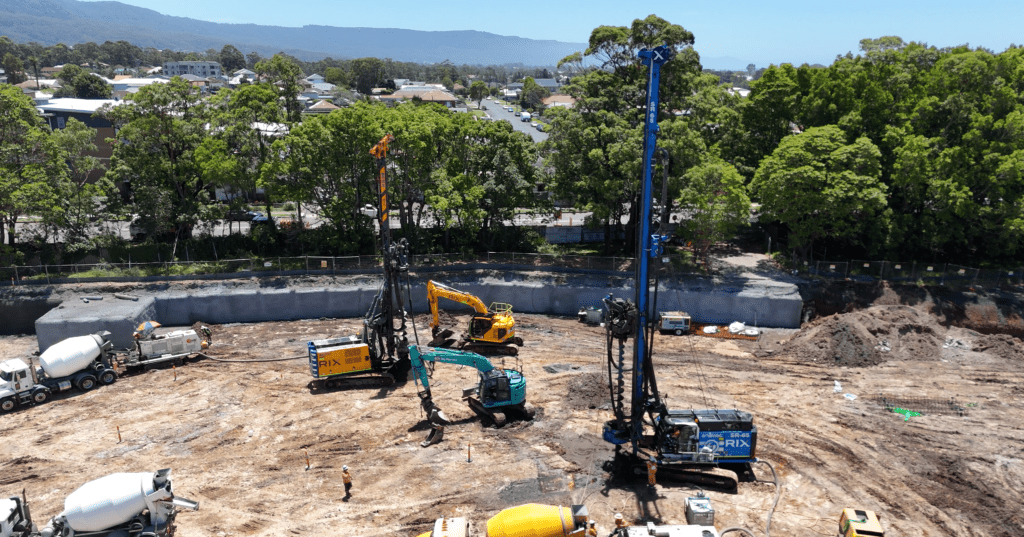
Continuous Flight Auger (CFA) piling is a bored, cast-in-place foundation method that forms concrete piles using a hollow-stem auger.
Trusted for relatively low noise and vibration, efficient installation and versatility across many ground conditions, these piles are widely used for buildings, retaining structures and civil infrastructure.
In this guide, we explain what CFA piling involves, its benefits, limitations, installation process, and differences from driven and rotary bored piles. Keep reading to learn whether this is the right piling method for your project.
Key takeaways
- CFA piles are widely used for deep foundations and retaining systems, including commercial and residential buildings, basements, secant and contiguous pile walls, bridges and civil infrastructure.
- Low noise and vibration make CFA piling well suited to built-up and sensitive sites, particularly where piling takes place close to existing buildings or operating infrastructure.
- The continuous installation process can achieve high production rates, with drilling and concreting completed in sequence and temporary casing often unnecessary in suitable ground.
- CFA piling works across many cohesive and granular soils, but hard rock, boulders, major obstructions and some unstable or highly variable ground conditions can make other piling methods more suitable.
- CFA piles can be engineered for compression, uplift and lateral loads, with pile depth, diameter and reinforcement designed around the structure and ground conditions.
- CFA, driven and rotary bored piles each suit different project conditions: CFA piling prioritises low-disturbance, efficient installation, driven piling produces little excavated spoil; and rotary bored piling offers greater flexibility for large diameters, heavy reinforcement and rock drilling.
- Successful CFA piling depends on controlled installation and quality assurance, including accurate set-out, drilling depth, concrete placement, reinforcement, installation records and testing.
What is CFA piling?
A CFA pile is a bored, cast-in-place concrete element used to transfer structural loads into suitable ground at depth.
This piling method uses a hollow-stem continuous flight auger, which drills to the required pile depth while bringing excavated soil to the surface.
Once the auger reaches its design depth, concrete is pumped through the hollow stem as the auger is steadily withdrawn, filling the bore from the bottom up.
A steel reinforcement cage is then inserted into the fresh concrete to provide the required reinforcement for buildings, retaining structures and civil infrastructure.
As drilling and concreting form part of a continuous sequence, CFA piling avoids leaving a conventional unsupported open bore.
In suitable ground conditions, this often removes the need for temporary casing and makes CFA piles an efficient foundation solution for buildings, retaining structures and civil infrastructure.
The most common CFA piling applications
CFA piling is used for deep foundations, retaining systems and excavation support across building, civil and infrastructure projects.
Its relatively low noise and vibration compared with driven piling make it particularly useful on built-up sites, near existing structures and where ground disturbance needs to be carefully controlled.
Let’s take a closer look at its typical applications, depending on ground conditions, groundwater, obstructions, pile depth, structural loads and available rig capacity.
Structural foundations
CFA piles transfer structural loads through weaker near-surface soils into stronger ground at depth. They are used for commercial buildings, residential developments, industrial facilities and other structures where shallow foundations cannot provide the required bearing capacity or settlement performance.
Pile diameter, depth, spacing and reinforcement are designed around the imposed loads and site-specific ground conditions.
Contiguous and secant pile walls
CFA piles can form contiguous and secant pile walls for temporary or permanent earth retention. Installed in a controlled sequence and spacing, the piles create a retaining system around basements, excavations and site boundaries.
These walls can be particularly useful where works take place close to neighbouring buildings, roads or other sensitive assets and ground movement must be carefully managed.
Basements and deep excavation support
CFA piles can support deep excavations where unsupported ground would be unstable or surrounding structures limit allowable movement. They are often incorporated into retaining systems for basements, pits and other below-ground structures.
Depending on the excavation depth, retained height and design loads, the pile wall may act as a cantilever or work with anchors, props or other bracing systems.
Bridge and transport infrastructure
CFA piles can provide deep foundation support for bridge abutments, bridge widening works, retaining structures and other transport infrastructure. Their low-vibration installation method can be valuable on projects close to operating roads, rail corridors or existing structures.
The piling design is matched to the required loads, ground profile, construction access and project constraints.
Embankment and civil infrastructure support
CFA piles can also support embankments and other civil structures where weak or compressible ground cannot provide adequate support on its own. By transferring loads into stronger material below, the piles can help control settlement and improve foundation performance.
They may form part of a wider ground support system alongside pile caps, load-transfer platforms or other engineered measures, depending on the project design.
The benefits of CFA piling
CFA piling combines efficient installation with high structural capacity, relatively low site disturbance and flexibility across a range of ground conditions.
Vibration-free with less noise
CFA piling produces relatively low noise and vibration because the auger rotates into the ground rather than driving piles with repeated hammer impacts.
This makes the method particularly useful in built-up or environmentally sensitive areas, transport corridors and sites close to existing structures, where reducing disruption to surrounding properties and operations is important.
Supports demanding structural loads
CFA piles can be designed to resist substantial compression loads and, with appropriate reinforcement, uplift and lateral forces. Pile capacity depends on factors including diameter, depth, reinforcement, ground conditions and the interaction between the pile and surrounding soil.
Engineers tailor the pile design to the structural loads and geotechnical conditions of each project, helping achieve the required foundation performance.
Suits a wide range of ground conditions
CFA piling can work effectively across many cohesive and granular soils, including clays, silts and sands, as well as some gravelly soils and weaker material where the drilling equipment can penetrate effectively.
During installation, the continuous auger helps control the surrounding ground while excavated material is brought to the surface. Concrete is then pumped through the hollow stem under controlled pressure as the auger is withdrawn, forming the pile without leaving a conventional open bore.
Large cobbles, boulders, significant obstructions and competent rock can limit CFA installation, so suitability should be confirmed through geotechnical investigation and project-specific design.
Fast, continuous installation
CFA piling can achieve high installation rates because drilling and concreting form part of one continuous construction sequence. Once the auger reaches the required depth, concrete is pumped through its hollow stem as it is steadily withdrawn, forming the pile from the bottom up.
In suitable ground conditions, the method can also avoid the need for temporary casing or drilling support fluids. Fewer construction stages can simplify piling operations, reduce supporting plant requirements and help keep the wider construction program moving.
When to use alternative piling methods
While CFA piling suits a wide range of foundation and retaining applications, its suitability depends on several factors.
Ground conditions, groundwater, obstructions, structural loads, pile depth, site access and construction constraints all influence which piling method will perform most effectively.
Alternative piling methods may be more suitable in the following situations:
Hard rock, boulders or major obstructions
CFA piling relies on a continuous auger advancing through the ground, so large cobbles, boulders, hard rock and buried obstructions can restrict drilling or prevent the pile from reaching its required depth.
Where these conditions are expected, rotary bored piles, micropiles or another drilling method with specialised rock tooling may provide better penetration and control.
Highly variable or unstable ground
Very soft soils, loose water-bearing sands, underground voids and highly variable ground profiles can present additional challenges for CFA piling.
Hard layers beneath softer or loose material can also require careful drilling control to limit excessive soil removal and surrounding ground disturbance.
That said, these conditions don’t automatically rule out CFA piling.
The geotechnical profile, groundwater conditions, required pile performance, and available equipment should determine whether CFA, cased bored piles, displacement piles or another foundation method offers the most suitable solution.
Exceptional structural demands
CFA piles can be designed to resist compression, uplift and lateral loads when appropriately sized and reinforced.
Another piling method may be more practical where the project requires very large pile diameters, substantial reinforcement, significant bending resistance or penetration into competent rock.
The final choice depends on the structural loads, ground conditions and foundation design.
Restricted access or headroom
CFA piling requires suitable access for the piling rig, concrete supply and spoil-handling equipment, along with adequate headroom and a stable working platform.
Where access is severely restricted, smaller systems such as micropiles may offer a more practical solution.
As compact CFA rigs can also suit some constrained sites, available equipment should be considered as part of the site assessment.
Sites where spoil removal is difficult
CFA piling brings excavated material to the surface as the auger advances, creating spoil that must be handled, stored and removed from the work area.
On confined sites, or where excavated material requires controlled disposal, this can add to site logistics. Driven or displacement piling may be more suitable where minimising excavated spoil is a priority.
The differences between CFA piles, rotary bored piles and driven piles
The main difference between CFA, rotary bored piles and driven piles is how each foundation is constructed. As described above, CFA piles are formed in the ground using a hollow-stem auger and concrete.
In contrast, driven piles are manufactured before installation, often from precast concrete or steel, and driven into the ground using piling equipment.
With rotary bored piling, the bore is excavated first, the reinforcement cage is lowered into position, and concrete is then placed to form the pile. On the other hand, CFA piles are drilled and concreted as one continuous process.
The right choice depends on ground conditions, structural loads, noise and vibration limits, site access, spoil management and project requirements.
CFA vs driven vs rotary bored piles
| Factor | CFA piles | Driven piles | Rotary bored piles |
| Installation method | A hollow-stem continuous flight auger drills to the required depth. Concrete is pumped through the stem as the auger is withdrawn, then reinforcement is inserted into the fresh concrete. | Preformed piles, commonly steel or precast concrete, are driven into the ground using impact, vibratory or other suitable piling equipment. | The bore is excavated first using rotary drilling tools. Reinforcement is generally lowered into the completed bore before concrete is placed. |
| Pile type | Cast-in-place reinforced concrete pile. | Preformed displacement pile. | Cast-in-place reinforced concrete pile. |
| Bore support | The auger remains in the bore until concreting starts, which can reduce the need for temporary casing or drilling fluids in suitable ground. | No excavated bore is created because the pile displaces the surrounding ground during installation. | The bore may remain open or require temporary casing, permanent lining or drilling support fluids, depending on ground and groundwater conditions. |
| Ground conditions | Suits many clays, silts and sands, as well as some gravelly soils and weaker material. Major obstructions, boulders and competent rock can restrict installation. | Can perform effectively in many soft, loose and suitable granular or cohesive soils. Hard layers, obstructions and difficult driving conditions can restrict penetration. | Offers greater flexibility across variable ground because different augers, buckets and rock-drilling tools can be selected as conditions change. |
| Rock drilling | Generally limited by the penetration capability of the CFA rig and auger. | Penetration into hard rock is generally limited, although piles may be driven to rock or dense bearing strata depending on the design. | Well suited where drilling into competent rock or forming a rock socket is required. |
| Pile size and depth | Available across a broad range of diameters and depths within the capability of the CFA rig and auger system. | Pile dimensions and achievable depth depend on the pile section, driving equipment and ground resistance. | Can accommodate large diameters and considerable depths, making it suitable for demanding foundation designs. |
| Reinforcement | The reinforcement cage is inserted into fresh concrete after concreting, which can place practical limits on cage length and reinforcement density. | Reinforcement is incorporated into precast concrete piles where required, while steel piles rely on the structural steel section itself. | The reinforcement cage is generally installed before concreting, allowing substantial or full-depth reinforcement where required. |
| Structural performance | Can be designed for compression, uplift and lateral loads. | Can carry substantial axial and lateral loads, subject to pile type, ground conditions and structural design. | Often selected for very high loads where large diameters, substantial reinforcement, greater depths or rock sockets are required. |
| Noise and vibration | Relatively low noise and vibration compared with driven piling. | Impact driving can generate considerably more noise and ground vibration. | Relatively low vibration because the pile bore is drilled rather than formed through impact driving. |
| Spoil generation | Generates excavated spoil as material travels up the auger flights. | Generally produces little or no bored spoil because surrounding ground is displaced rather than excavated. | Generates excavated spoil, with volume influenced by pile diameter, depth and drilling method. |
| Installation speed | Can achieve high production rates because drilling and concreting form part of a continuous sequence. | Can achieve fast installation rates where pile supply, ground conditions and access suit the method. | Requires separate excavation, bore preparation, reinforcement and concreting stages, with production rates dependent on pile size and ground conditions. |
| Typical applications | Urban developments, basements, retaining walls, commercial foundations and civil works where low disturbance is important. | Bridges, marine structures, industrial facilities and civil infrastructure where displacement piling suits the site. | Heavily loaded structures, major infrastructure, deep foundations and projects requiring large diameters, substantial reinforcement or rock sockets. |
| Often preferred when | Low noise, low vibration and efficient installation are priorities. | Minimising excavated spoil and using a preformed displacement pile offer project advantages. | Ground conditions, loads or pile geometry require greater drilling flexibility, depth, diameter or reinforcement capacity. |
How to install CFA piles
CFA piles are installed in a continuous sequence of drilling, concrete placement and reinforcement.
This process uses a hollow-stem auger to reach the required depth, then concrete is injected as the auger is withdrawn before the reinforcement cage is placed into the fresh concrete.
Let’s take a closer look at each step.
1. Prepare and set out the site
A stable working platform is established to support the piling rig and associated equipment. Site access is confirmed, underground and overhead services are identified, and each pile position is set out in accordance with the approved design.
The rig is then positioned over the pile location and the mast aligned to achieve the specified pile position and verticality, or designed inclination where applicable.
Accurate set-out helps maintain installation tolerances and ensures each pile is constructed in the correct location.
2. Drill to the required depth
A hollow-stem continuous flight auger rotates into the ground until it reaches the specified pile depth or toe level. As the auger advances, excavated material travels up the flights towards the surface.
Unlike conventional bored piling, CFA construction does not require the auger to be removed before concreting begins.
Keeping the auger within the bore until concrete placement starts helps support the surrounding ground and avoids leaving a conventional unsupported open bore. In suitable conditions, this can reduce the need for temporary casing.
3. Pump the concrete
Once the auger reaches the required depth, concrete is injected through the hollow stem under controlled pressure as the auger is progressively withdrawn.
This forms the pile from the toe upwards while concrete replaces the space occupied by the auger.
Concrete delivery is coordinated with the rate of auger extraction to maintain a continuous supply throughout the pile.
Depending on the equipment and project requirements, installation parameters can be monitored and recorded to support quality control and provide a detailed record of the piling operation.
4. Install the reinforcement cage
After concreting, the reinforcement cage is inserted into the fresh concrete to the depth and position specified in the pile design.
The cage length, diameter and reinforcement arrangement depend on the structural demands of the pile.
Where required, appropriate installation equipment can assist with placing the cage to the specified depth.
5. Quality control and testing
Quality control continues throughout CFA pile construction rather than occurring only after installation.
Installation records help confirm that each pile has been constructed in accordance with the approved design, project specifications and required tolerances.
Depending on the project, quality documentation may include pile installation logs, concrete and reinforcement records, survey information, as-built records and pile testing results.
Where required, these records support certification and provide traceability that the completed CFA piling works meet the specified project requirements.
Discover CFA piling for construction projects in Australia and the Asia Pacific
Effective CFA piling relies on appropriate design, machinery selection, and installation. Ground conditions, structural loads, access and groundwater all shape the outcome.
At The RIX Group, we bring in-house engineering, specialist piling equipment and experienced crews together to deliver tailored CFA piling solutions across Australia and the Asia Pacific.
Contact our CFA piling contractors to discuss your next project.